Pushing harder for risk management in medical labs is completely missing the point.
If you want real change, pushing harder isn't the answer. Removing what is blocking you is.
Over thirty years ago, I was learning and teaching Lewin’s Force Field Analysis. It taught me a fundamental lesson: if you actually want to move positive change forward, efforts spent removing restraining forces have far more impact than simply promoting driving forces.
Yet, look at medical laboratories today.
Risk Management has been recommended and required by ISO 15189 and CLSI EP23-A for years. We keep preaching the benefits, but adoption remains painfully slow.
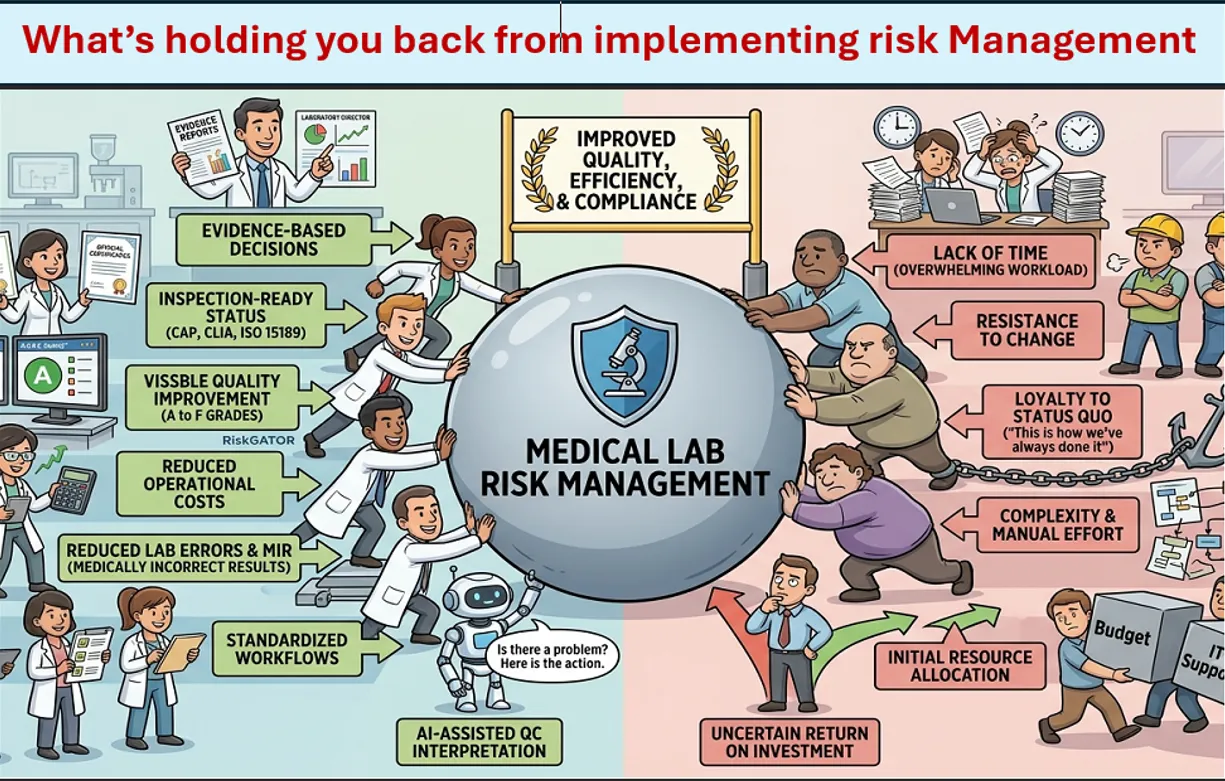
The image shows why this tug-of-war is happening:
The Driving Forces (Why we push):
- Evidence-Based Decisions & Inspection-Ready Status: Meeting CAP, CLIA, and ISO 15189 compliance seamlessly.
- Error & Cost Reduction: Reducing Medically Incorrect Results (MIRs) and cutting unnecessary operational costs.
- Modern Efficiency: Standardized workflows and AI-assisted QC interpretations. Do more with fewer staff in these days of staff shortages and retiring expertise.
The Restraining Forces (What is holding us back):
- Lack of Time: Lab teams are overwhelmed by daily operational workloads.
- Loyalty to the Status Quo: The classic "This is how we’ve always done it" mindset. (Oh how often I have heard that one! At one of my workshops the staff listed the lab manager as a restraining force preventing better QC practice.)
- Complexity & Resource Allocation: Fear of manual effort, initial costs, and an uncertain ROI.
When we try to force adoption by shouting louder about compliance or ROI, we only make staff dig their heels in. The trick isn't adding more pressure to the driving side—it’s systematically removing the friction on the restraining side.
Automate the complex manual efforts. Clear the operational hurdles. Make adoption easier than staying with the status quo. This is what I have been working on with RiskGATOR software.
What is the single biggest restraining force holding your lab back from fully adopting Risk Management today? How can we remove the forces preventing more efficient lab QC processes, lower patient risk and healthcare cost?